What 16 months of AI content experiments actually revealed, Google’s new web agent, Plus where influence really happens across 5,000 of the web’s most visited sites
Hi friends,
Welcome to the new issue of HighDegree*: Cutting Through the Noise in SEO & Digital Marketing
Three big questions dominated SEO conversations this week: Are your Google Search Console numbers actually telling the truth? Does AI-generated content still have a shot at ranking? And where does influence really happen if social and search are just the starting points? We also dig into Google’s new AI Agent crawling your website on behalf of real users and what that means for your server logs, your strategy, and your business.
Let’s jump in.
➞ In this Week
- Google Search Console’s branded query filter is rewriting how we read organic performance and some brands are discovering their SEO was working better than they thought
- A new Semrush study of 42,000 blog posts settles the “does AI content rank?” debate, with a clear verdict
- SparkToro analyzed 5,000 of the most-visited websites and found influence is far more fragmented than any funnel diagram suggests
- Google quietly launched Google-Agent, a new user-triggered web crawler tied to its AI agents and it’s already visiting sites
- A 16-month experiment on 20 AI-only domains confirms the limits of unedited AI content in organic search
➞ Your GSC Data Has Been Mixing Branded and Non-Branded Traffic, Here’s What Changes Now
For years, SEOs built workarounds to separate branded from non-branded search traffic in Google Search Console (GSC) — regex filters, custom Looker Studio dashboards, third-party tools. All of them were messy, inconsistent, and hard to maintain. That gap is now closed.
Google rolled out a native branded query filter in GSC in November 2025, and it’s now available across all eligible properties. The feature lets you isolate brand-name searches from organic discovery traffic inside the Performance Report, without any workarounds.
Why does it matter? Because branded search traffic inflates your organic numbers. When someone types your company name into Google, that shows up as organic performance, even if they already knew about you from an ad, a podcast mention, or word of mouth. Your SEO dashboard looks great, but your actual search discovery work gets credit it didn’t earn.
One analysis comparing the old regex method against the new filter found that a well-known e-commerce brand went from an apparent 39.7% brand share down to 21.2%, meaning non-brand traffic contribution was almost double what old reports suggested.
For bloggers and small business owners, this changes how you report to clients, how you benchmark campaigns, and how you assess whether your content strategy is actually working.
Read the full report from searchengineland.com ➞
➞ Human-Written Content Dominates Google’s Top Spots, AI Alone Won’t Get You There
Semrush analyzed 20,000 keywords and 42,000 blog posts to answer the question every content creator is asking: does AI-generated content rank?
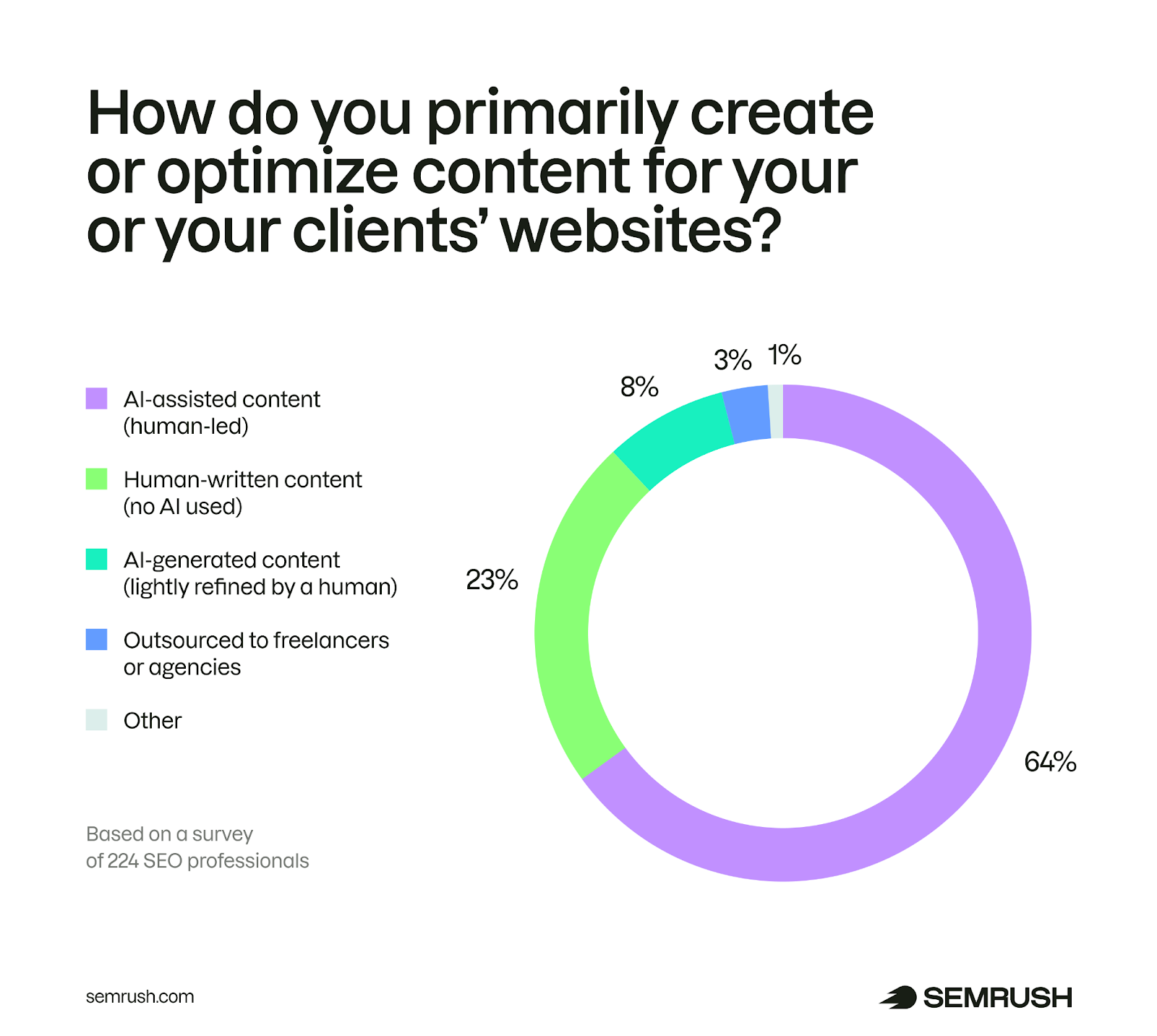
The short answer is yes, but it’s not leading the pack. Human-written pages hold the No. 1 position 80% of the time versus just 9% for purely AI-generated content. Mixed content (AI-assisted with human editing) falls somewhere in between.
What this tells you in practical terms: Google isn’t penalizing content for being AI-generated. The issue is quality, not origin. Thin, unedited, generic AI output doesn’t give searchers a reason to stay on the page and Google notices.
The takeaway for bloggers and webmasters isn’t “avoid AI.” It’s “don’t publish raw AI output.” Use AI to research, outline, and draft. Then bring in your own experience, expertise, and editorial judgment before hitting publish. That combination, speed from AI, substance from you, is where the actual ranking advantage sits.
If you’re running a content-heavy site and wondering why traffic isn’t growing, the Semrush data is worth a close read.
Read the full report from semrush.com ➞
➞ Where Does Influence Actually Happen? Everywhere Except Where You’re Focusing
SparkToro’s Rand Fishkin analyzed Similarweb clickstream data across the 5,000 most-visited websites in January 2026, and the results challenge how most marketers think about their channel strategy.
Search and social together account for nearly half of all web visits among the top 5,000 domains. Google alone commands roughly 73% of search traffic, making it the biggest single destination on the web. But Google mostly acts as a middleman: people arrive with intent already formed, not inspiration still forming.
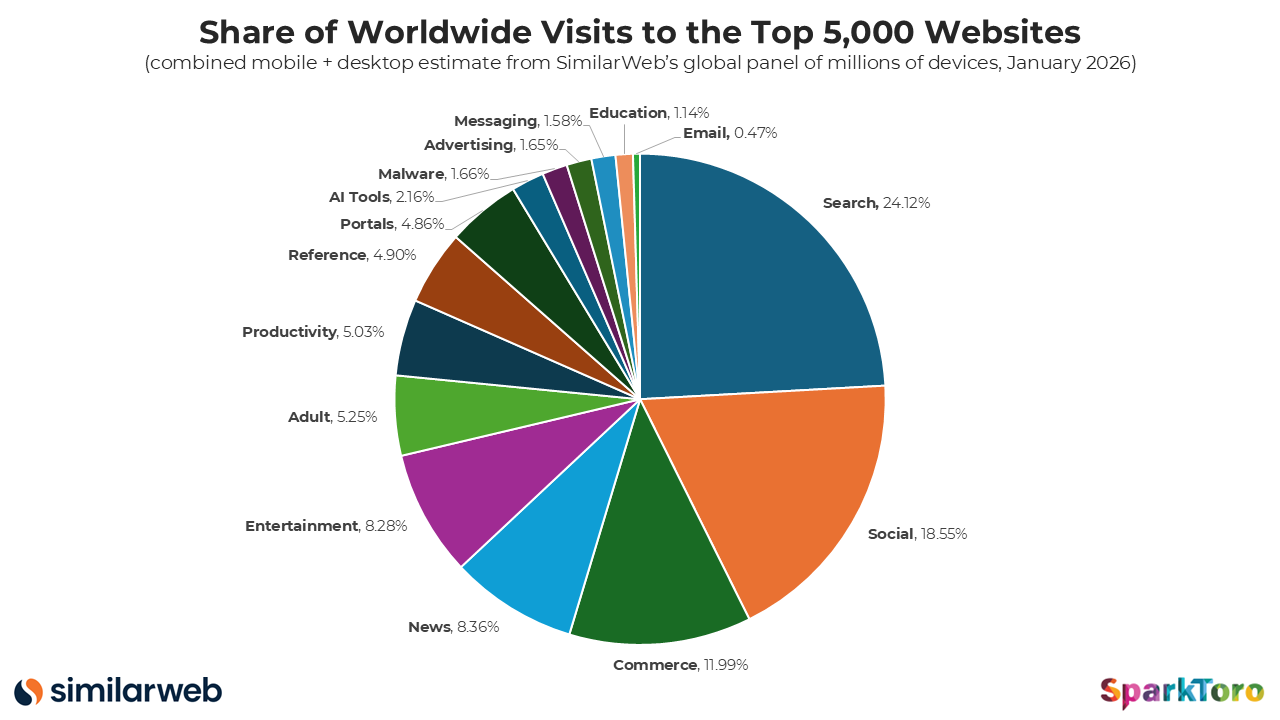
The more important finding is what happens before people search. Influence, the part that shapes what people want, what they trust, and what they buy, is fragmented across news sites, email, messaging apps, entertainment, and social platforms. If you’re only optimizing for search, you’re showing up at the end of a journey you had no hand in shaping.
For small business owners and bloggers, this is a call to think beyond rankings. Email lists, niche communities, podcast appearances, and social content all build the kind of ambient awareness that eventually turns into branded search; which now, thanks to GSC’s new filter, you can actually track separately.
Read the full report from sparktoro.com ➞
➞ Google-Agent Is Now Crawling Websites on Behalf of Real Users, Here’s What That Means
On March 20, 2026, Google added a new entry to its user-triggered fetchers documentation: Google-Agent. Unlike Googlebot, which crawls your site to index content, Google-Agent visits your pages because a real person asked a Google AI agent to do something on their behalf, browse a product, fill a form, book a service, or pull information.
Google named Project Mariner as an early example, a Chrome-based AI agent that can complete tasks for users. Access is limited now, but the rollout is underway.
For site owners, this has a few immediate implications. First, check your server logs. Google-Agent visits should start appearing soon, and knowing how often agents are hitting your pages gives you early signal about AI-driven traffic. Second, think about what happens when an agent lands on your site, can it complete a task clearly? Is your information structured and easy to parse? Third, if you’re blocking crawlers for speed or security reasons, make sure you’re not accidentally blocking Google-Agent before understanding what it does.
This is early-stage infrastructure, but it’s the beginning of a shift from search-and-click to search-and-do.
Read the full report from semrush.com ➞
➞ 16 Months, 20 Domains, 2,000 AI Articles, Here’s What Actually Happened
A team at Search Engine Land and SE Ranking ran one of the most concrete experiments on AI content in organic search: 20 brand-new domains, each publishing 100 fully AI-generated articles on long-tail keywords, tracked for 16 months with zero human editing.
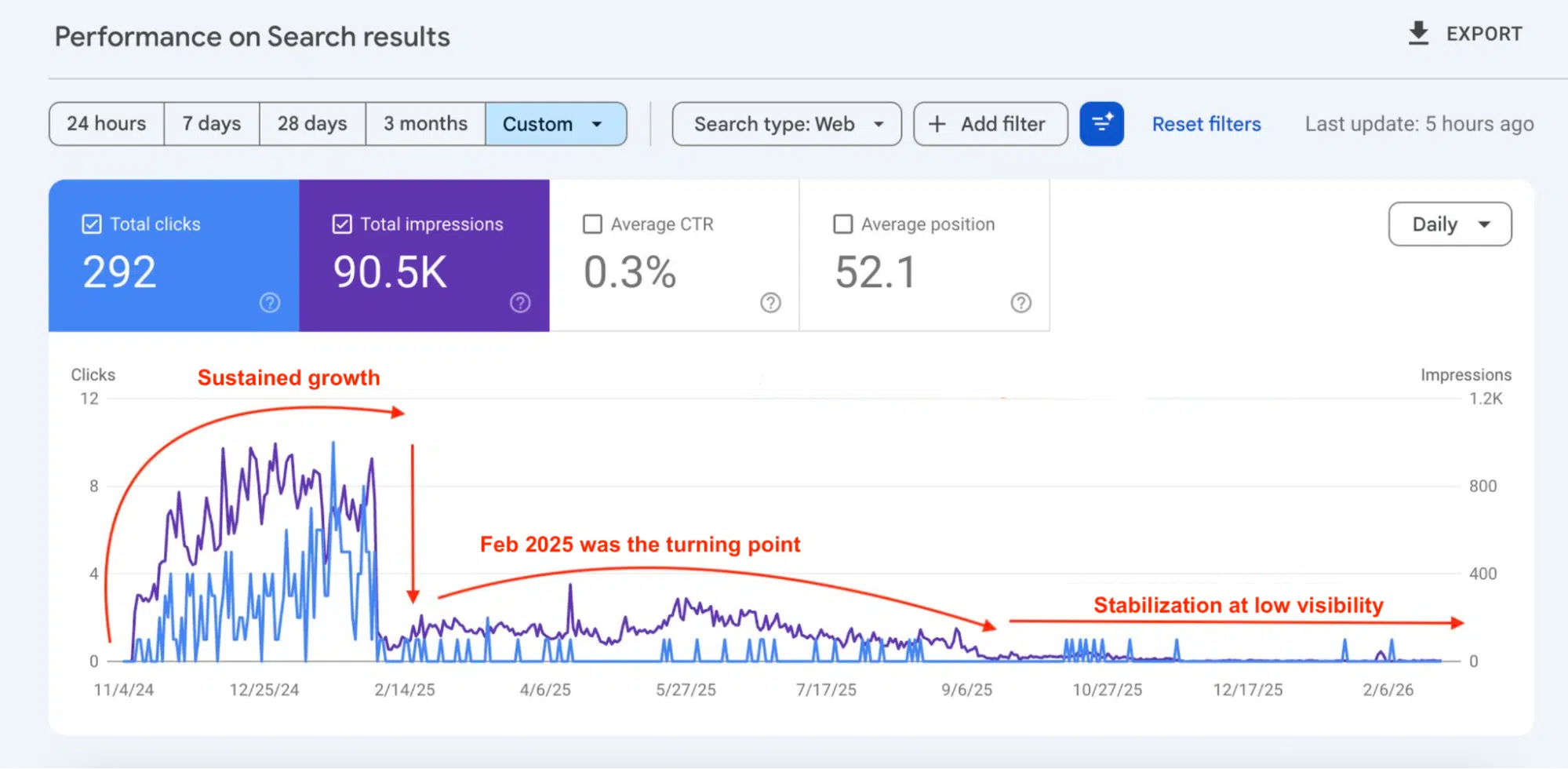
The results were hard to call a success. In month one, 28% of pages ranked in the top 100. By month three, that number dropped to 3%. By month 16, most pages remained indexed but rarely appeared in actual search results. Traffic and impressions were concentrated in the early growth window, before Google apparently reassessed the content’s value.
What the experiment doesn’t show is that AI content is worthless. What it does show is that raw, unedited AI content on a brand-new domain, with no backlinks, no authority, no human perspective, isn’t a sustainable search strategy.
Google isn’t rejecting pages because AI wrote them. It’s sorting results the same way it always has: by usefulness, trust, and whether your content is better than what’s already out there. AI content can participate in that race, but it needs a real strategy behind it, original angles, human editing, proper technical SEO, and time to build authority.
Read the full report from searchengineland.com ➞
➞ From Google
Everything from Google Search this week —
→ GSC Logging Error Yielded Inflated Impressions Since May 2025 (seroundtable.com)
→ Google Explains Why It Doesn’t Matter That Websites Are Getting Larger (searchenginejournal.com)
→ Google’s Mueller On SEO Gurus Who Are “Clueless Imposters” (searchenginejournal.com)
→ Are low-quality listicles about to lose their edge in Google Search? (searchengineland.com)
→ Google quietly launched an AI dictation app that works offline (techcrunch.com)
→ An update on our mental health work (blog.google)
→ Create, edit and share videos at no cost in Google Vids (blog.google)
→ New ways to balance cost and reliability in the Gemini API (blog.google)
→ Google On Why Core Updates Take Weeks To Fully Roll Out (seroundtable.com)
→ Inside Googlebot: demystifying crawling, fetching, and the bytes we process (developers.google.com)
→ New Location for the Google Crawlers’ IP Range Files (developers.google.com)
→ Improve coding agents’ performance with Gemini API Docs MCP and Agent Skills (blog.google)
→ Build with Veo 3.1 Lite, our most cost-effective video generation model (blog.google)
→ Google May Call, Text or WhatsApp To Confirm Business Details (seroundtable.com)
→ Google Review Guidelines 2026 Update (searchlabdigital.com)
→ Ask Maps is now available to everyone in the U.S. and India (x.com)
→ Timeline Chart Added to PMAX Channel Report (ppcnewsfeed.com)
→ Google Ads PMax Asset Group Theming (seroundtable.com)
→ Auto-Apply Option Added to Experiments (ppcnewsfeed.com)
→ Google is fixing a Search Console bug that inflated impression counts (searchengineland.com)
→ Google Answers Why Some SEOs Split Their Sitemap Into Multiple Files (searchenginejournal.com)
→ Google Maps simplifies battery predictions and trip planning for 350+ Android Auto EV models (blog.google)
→ Is Google Ditching Blue Background For AI Citations? (seroundtable.com)
→ Google Search Console Performance Report Impressions Spiking??? (seroundtable.com)
→ Google: Pages Are Getting Larger & It Still Matters (searchenginejournal.com)
→ Google Gemini Sends More Traffic To Sites Than Perplexity: Report (searchenginejournal.com)
→ New Google TurboQuant algorithm improves vector search speed (searchengineland.com)
→ YouTube test replaces video titles with AI summaries (searchengineland.com)
→ YouTube expands Shopping Affiliate Program access (socialmediatoday.com)
→ Google March 2026 Core Update Is Rolling Out – First Core Update Of Year (seroundtable.com)
→ Google March 2026 Spam Update Unleashed (& Finished) (seroundtable.com)
→ Google Adds Properties For Discussion Forum & QA Page Markup & Documents Robots Tags Outside HTML Head (seroundtable.com)
→ Gemini 3.1 Flash Live: Making audio AI more natural and reliable (blog.google)
→ Make the switch: Bring your AI memories and chat history to Gemini (blog.google)
→ Google Tests Huge Block of Citations at Bottom of AI Overviews (seroundtable.com)
→ Google AI Mode Tests Changing Some Links To Overlay Cards – Reducing Clicks (seroundtable.com)
→ Google Tests “Skip Digging, Start Guided Research” Driving Users to Web Guide-like Results (seroundtable.com)
→ More ads in AI Mode — Two interesting AI mode findings (x.com)
→ Google PMax gets new exclusions, expanded reporting features (searchengineland.com)
→ Google is testing AI-generated animated video clips inside PMax (searchengineland.com)
→ Google To Expand Shopping Ads To 15 New European Markets (seroundtable.com)
→ Google Ads Expanding Loyalty Program (seroundtable.com)
→ Google Merchant Center: Out-of-Stock Products Need Grayed Out Buy Button (seroundtable.com)
➞ AI + Social
Find out what’s happening in the social media and artificial intelligence world —
→ Bing, not Google, shapes which brands ChatGPT recommends (searchengineland.com) – A new study shows ChatGPT’s brand recommendations correlate more with Bing rankings than Google’s, a wake-up call for anyone focused only on Google for AI visibility.
→ Why Agentic AI Shopping Feels Unnatural And May Not Threaten SEO (searchenginejournal.com) – Despite the hype, AI-driven shopping agents still feel clunky to most users. The SEO threat may be overstated for now.
→ How to use the new ChatGPT app integrations, including DoorDash, Spotify, Uber, and others (techcrunch.com) – ChatGPT now connects directly to third-party apps so users can order food, play music, and book rides without leaving the chat. Agentic AI just went mainstream.
→ OpenAI acquires TBPN, the buzzy founder-led business talk show (techcrunch.com) – OpenAI is moving into media. This acquisition signals a push into content and distribution beyond the core AI product.
→ ChatGPT Search Is Citing Fewer Sites, Data Shows (searchenginejournal.com) – The pool of sources ChatGPT pulls from is narrowing. If you’re not already being cited, getting in is getting harder.
→ Anthropic says Claude Code subscribers will need to pay extra for OpenClaw usage (techcrunch.com) – Anthropic is adding a separate pricing layer for advanced agentic features inside Claude Code.
→ Trust In AI Search Could Drop With Ads, Survey Shows (searchenginejournal.com) – Users trust AI search results significantly less when ads appear alongside them. Worth watching as Google and OpenAI both monetize AI mode.
→ Instagram chief debunks popular engagement hack (socialmediatoday.com) – Instagram’s head publicly clarified that a widely shared growth tactic doesn’t actually work. If you’ve been using it, now you know.
→ 2026 LinkedIn Benchmarks (socialinsider.io) – Fresh data on what average engagement, reach, and follower growth look like on LinkedIn this year. Useful for calibrating your expectations.
→ Questions linger about the long-term viability of X (socialmediatoday.com) – Advertiser hesitation, monetization reversals, and co-founder departures are keeping questions about X’s future very much open.
→ Grokipedia Continues To Drop in Search Visibility And AI Search Visibility (seroundtable.com) – xAI’s Wikipedia alternative keeps losing ground in both traditional and AI search. A useful case study in how quickly AI tools can fall out of favor.
→ TikTok wants to provide financial services in Brazil (socialmediatoday.com) – TikTok is expanding well beyond video. Financial services in Brazil is its latest push into platform diversification.
→ TikTok expands HubSpot integration (socialmediatoday.com) – TikTok’s CRM tie-in with HubSpot deepens, making it easier to connect ad performance directly to sales pipeline data.
→ TikTok and ACRCloud partner on Derivative Works Detection system (socialmediatoday.com) – TikTok is adding music copyright detection tools. Important for creators who remix or sample audio.
→ Anthropic Accidentally Exposes System Behind Claude Code (bloomberg.com) – Anthropic briefly exposed internal source code for Claude Code, raising questions about AI infrastructure security practices.
→ Introducing llms.txt to Shopify: Give AI a map to your best products (yoast.com) – Yoast’s integration now adds llms.txt support to Shopify stores, a growing standard that helps AI models understand your site’s most important content.
→ ChatGPT enables location sharing for more precise local responses (searchengineland.com) – ChatGPT can now use your location to deliver more relevant local results. Local SEO just got a new angle to think about.
→ OpenAI Adds Codex Plugins to Automate Workflows and Expand Beyond Coding (ghacks.net) – Codex is moving beyond code generation into general workflow automation. OpenAI is building in multiple directions at once.
→ You can now use ChatGPT with Apple’s CarPlay (theverge.com) – ChatGPT is now accessible through Apple CarPlay, extending OpenAI’s reach into yet another daily touchpoint.
→ Meta Unveils ‘Elite’ AI Research Team, Focus On Recommendations (mediapost.com) – Meta is building a dedicated team to improve AI-driven content recommendations across its platforms. Organic reach implications are worth watching.
→ YouTube creators can now like video comments in bulk (socialmediatoday.com) – Small but useful: YouTube rolled out bulk comment liking for creators to manage engagement more efficiently.
→ Snapchat trolls Meta with Spotlight name change prank (socialmediatoday.com) – Snapchat briefly renamed Spotlight to troll Meta. Petty, but tells you something about the competitive temperature between platforms.
→ GPT drafts, Claude critiques: Microsoft blends rival AI models in new Copilot upgrade (geekwire.com) – Microsoft’s Copilot now uses OpenAI to generate and Anthropic’s Claude to review, a multi-model workflow baked into a mainstream product.
→ Bing Shopping Tests AI-Based Recommendations (seroundtable.com) – Bing is testing AI-driven product recommendations in Shopping. Relevant given Bing’s outsized influence on ChatGPT’s recommendations.
→ BREAKING: “SKILLS” WILL COME TO GROK SOON! (x.com) – Leaked indicators suggest Grok is getting a “Skills” feature similar to GPT plugins. One to watch.
→ All 11 xAI co-founders have now reportedly left Elon Musk’s AI company (thenextweb.com) – Every original co-founder of xAI has reportedly departed. The company continues operating, but the founding team is gone.
→ Bluesky leans into AI with Attie, an app for building custom feeds (techcrunch.com) – Bluesky is adding AI-powered feed customization. If you’re building a presence there, this changes how content discovery works.
→ Apple removes vibe coding app from App Store (investing.com) – Apple pulled a popular vibe coding app without much explanation. A reminder of how dependent developers are on platform gatekeepers.
→ Meta to test premium subscriptions on Instagram, Facebook, and WhatsApp (techcrunch.com) – Meta is exploring paid tiers across its platforms. If it rolls out broadly, the organic reach calculation shifts again.
→ Meta shares new Facebook Content Monetization tips (socialmediatoday.com) – Meta published guidance on earning from Facebook content. Worth a read if you’re monetizing through the platform.
→ Reddit Pro opens to all publishers, adds new features in public beta (searchengineland.com) – Reddit’s brand tools are now open to all publishers. If Reddit is part of your distribution strategy, check what’s new.
→ LinkedIn shares tips on using articles to enhance engagement (socialmediatoday.com) – LinkedIn’s own guidance on articles, useful if long-form is part of your LinkedIn strategy.
→ LinkedIn will no longer allow real-time livestreams (socialmediatoday.com) – LinkedIn Live is going away. If you’ve been using it as a content channel, time to adapt.
→ X limits access to X Pro management app (socialmediatoday.com) – Access to X’s professional management tool is being restricted. Another friction point for brands running operations on X.
→ LEAKED: ANTHROPIC BUILT AN AI SO GOOD AT HACKING THEY’RE AFRAID TO RELEASE IT (x.com) – A leaked claim about an unreleased Anthropic model with advanced offensive security capabilities. Unverified, but making the rounds.
→ Apple Plans to Open Up Siri to Rival AI Assistants Beyond ChatGPT in iOS 27 (bloomberg.com) – Apple is reportedly planning to let users set third-party AI assistants as their default in iOS 27. A significant shift if it happens.
→ Jury reaches verdict in blockbuster Meta, YouTube social media trial (cnbc.com) – A major social media liability case reached a verdict. The outcome has potential implications for how platforms moderate content going forward.
→ Introducing TRIBE v2: A Predictive Foundation Model Trained to Understand How the Human Brain Processes Complex Stimuli (ai.meta.com) – Meta’s latest research model aims to understand how the brain processes content, early-stage, but with long-term implications for ad targeting.
→ WhatsApp rolls out multiple features to improve chats (socialmediatoday.com) – WhatsApp added several UX improvements. Worth checking if you use it for customer communication.
→ Human speech and presence help drive Reels engagement (socialmediatoday.com) – Meta’s own data confirms: Reels with a real person talking perform better. The human element still matters on social.
→ TikTok for Business introduces campaign to drive in-app shopping (socialmediatoday.com) – TikTok is pushing harder into commerce with dedicated in-app shopping campaign types.
→ TikTok adds new ad placement options offering higher exposure (socialmediatoday.com) – New TikTok ad placements are rolling out with higher visibility. Worth testing if you’re running TikTok ads.
→ Reddit introduces additional marketing tools designed for retailers (socialmediatoday.com) – Reddit is expanding its retail advertising toolkit. If you sell physical products, these tools are worth a look.
→ X announces, then retracts, updated revenue share incentives (socialmediatoday.com) – X reversed a monetization policy update within days of announcing it. Reliability issues continue for creators on the platform.
➞ Worth Reading
These are the articles that will help you refine your marketing knowledge —
→ How to build FAQs that power AI-driven local search (searchengineland.com)
→ Google Search Console MCP: Step by Step Setup Guide (OAuth + 20 Free Tools) (suganthan.com)
→ How to Build SEO Habits that Deliver Consistent Results (womenintechseo.com)
→ The content types most cited by LLMs (wix.com)
→ The SEO parasites buying, exploiting and ultimately killing online newsbrands (pressgazette.co.uk)
→ 56% Of CEOs Report No Revenue Gains From AI: PwC Survey (searchenginejournal.com)
→ Good SEO / Bad SEO: A Simple Guide to Product-led SEO (linkedin.com)
➞ What This All Means for Your Strategy
This week’s five pieces fit together more tightly than they might look at first glance. GSC’s branded filter and the 16-month AI experiment both point at the same thing: the metrics we’ve been using to evaluate content performance have been messier than we realized. Clean data is only valuable if what you’re creating holds up under scrutiny and raw AI output, on its own, doesn’t.
SparkToro’s influence research adds the bigger frame: search is where decisions get confirmed, not where they get made. If you want to show up in search consistently, you need to be building awareness across every channel that shapes what people want before they ever type a query.
And Google-Agent? That’s a preview of where search is heading, from “find it yourself” to “have an agent do it.” The sites that are clearer, faster, and more structured will have an edge when AI agents start completing tasks on behalf of users at scale.
The playbook that works across all five of these stories is the same: original, useful, human-guided content backed by clean reporting and a presence that stretches well beyond Google.
Until next week,
Nishat from HighDegree* Marketing
P.S. Have a question about implementing these strategies? Hit reply – we read every email and often feature reader questions in future issues.
➞ Who is Nishat Shahriyar?
I’ve been a Digital Marketing Strategist since 2007. Today I’m the Product Marketing Lead at Fluent Forms (a WordPress form and lead-generation plugin used by 700K people), FluentPlayer (a WordPress Video Player Plugin) and Ninja Tables (a WordPress table builder plugin used by 80K people). Before that, I led marketing at Fluent Support (a WordPress helpdesk plugin used by 10K people).
Connect with me on LinkedIn or follow me on X/Twitter at @rednishat for SEO & Marketing updates.