Your AI visibility data is finally here, but there’s a catch.
Hi Marketers,
Welcome to the new issue of HighDegree* Marketing: Cutting Through the Noise in SEO & Digital Marketing
This week felt like Google turned up the pressure on every front at once.
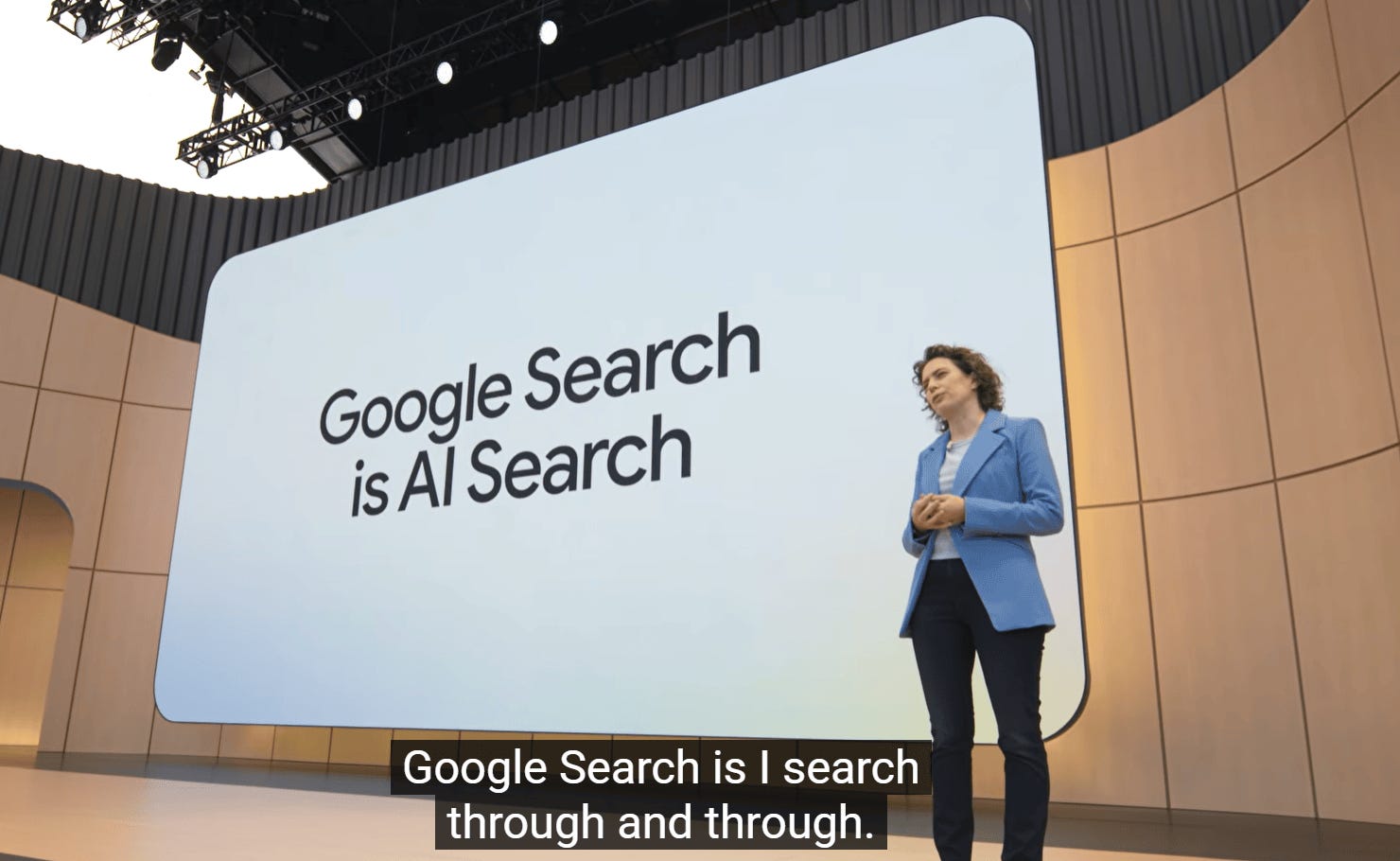
Google Search Console finally added dedicated AI performance reports, giving us our first real window into AI Overviews and AI Mode visibility. New research from 25,000 URLs shows which content format AI models cite most. The May core update finished rolling out with some rough final shockwaves. And Google launched creator Search Profiles just as the traffic question for publishers gets harder to ignore. We also dug into 19 ways to find out why your organic traffic dropped, because right now, more than a few sites have that exact question.
Let’s jump in.
➞ In this Week
- Google Search Console now reports your AI Overviews and AI Mode impressions separately
- Listicles dominate AI search citations across 25,000 URLs and 400 million data points
- The Google May 2026 core update finished rolling out, and the final shockwaves hit hard
- 19 ways to diagnose an organic traffic drop, including the newer AI Overviews factor
- Google launches Search Profiles for publishers and creators to manage their presence
➞ Subscribe
If you are not subscribed to HighDegree* yet, please subscribe to us by clicking the “Subscribe” button below. I will post every issue to HighDegree* substack version, so you can get it instantly in your inbox every time I hit publish!
Thanks for reading HighDegree* Marketing! Subscribe for free to receive new posts and support my work.
➞ Google Search Console Finally Shows Your AI Traffic, With One Big Catch
Google launched dedicated Generative AI performance reports in Search Console on June 3, 2026. For the first time, you can see how often your pages appear inside AI Overviews, AI Mode, and generative AI features in Discover, broken out separately from your standard organic data. The report shows impressions by page, country, device, and date.
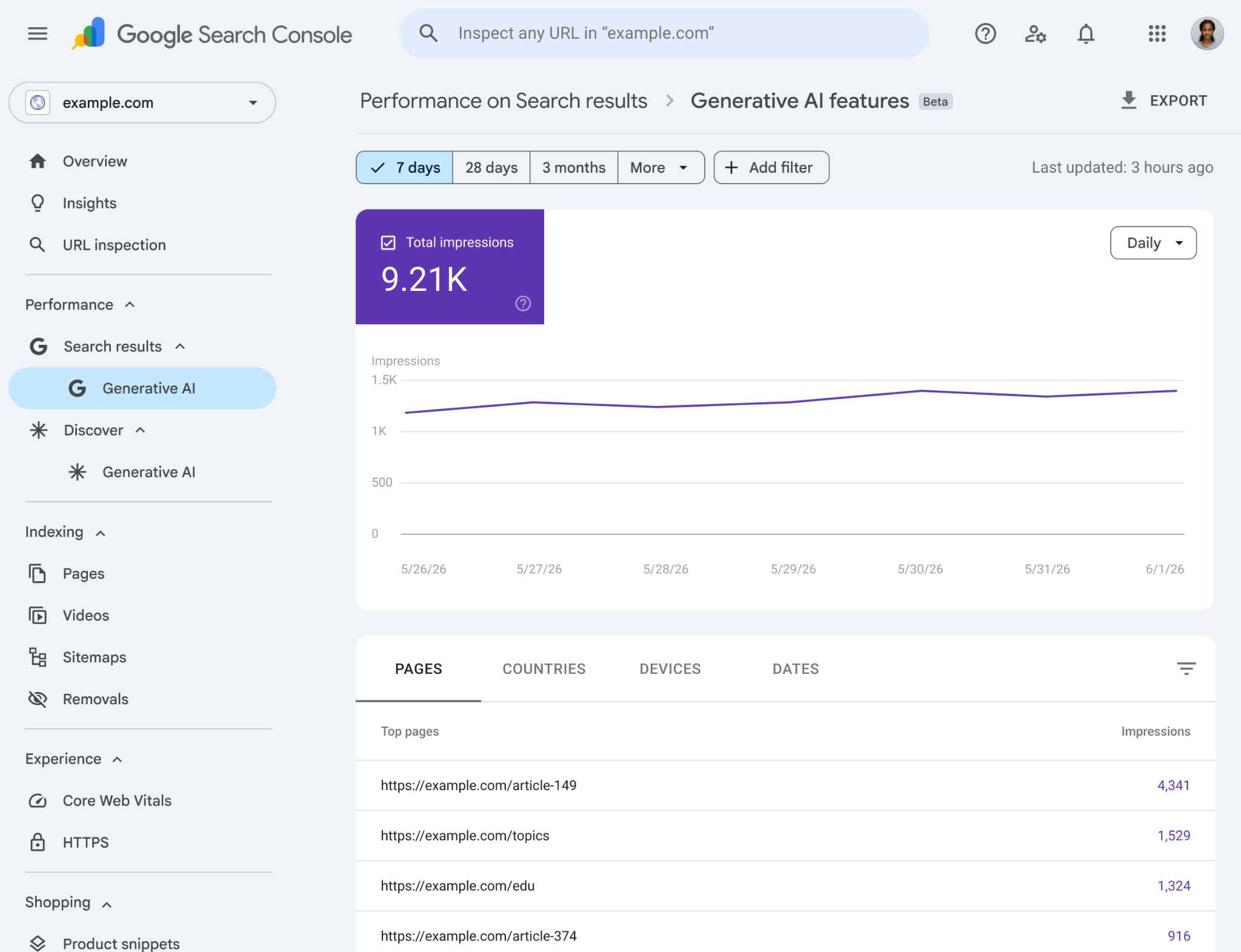
Here is the catch: no click data. You can see how visible you are inside AI search, but not how much traffic it is actually sending you. Google says more metrics will come “over time,” which means the measurement gap is half-closed, not fully resolved. Rolling out to a subset of sites first, with the UK getting access first before a broader global release.
Also alongside this: Google is testing a toggle that lets you opt your site out of AI Overviews and AI Mode entirely. For almost everyone, the answer is leave it on. Opting out means giving up the visibility you are now finally able to measure, and Google says it does not use the opt-out as a ranking signal elsewhere.
Check your Search Console now to see if the report has appeared for your property.
Read the full report from developers.google.com ➞
If getting impressions in AI search depends on the content you write, the next piece shows exactly which format is pulling the most citations across every major model.
➞ Want AI to Cite Your Content? Start Writing More Listicles
Evertune Research analyzed 25,000 unique URLs across ChatGPT, Copilot, Gemini, Google AI Mode, Google AI Overviews, and Perplexity to find out which content formats AI models cite most often. The result is hard to argue with: half of all cited URLs are listicles, and across nearly 400 million citations, 63% point to listicle-format pages.
Of those listicles, the most cited are ranked lists, the “Top 10” and “Best X” formats, not unranked bullet lists. For commercial-intent queries, the bias toward listicles is even stronger. There is also a structural pattern worth noting: 44% of all citations pull from the first 30% of a page, meaning what you put at the top matters more than what you bury in the middle.
This does not mean you should convert every article into a list. But if you are creating content targeting commercial keywords, and you have not structured it as a ranked, specific Top-N list, you are at a formatting disadvantage in AI search. The median cited page is around 941 words, not 3,000, so length alone does not drive AI citation.
Read the full report from searchengineland.com ➞
While you plan content to earn AI citations, your existing rankings may have just shifted, because the May core update had one more round in it.
➞ The Google May Core Update Just Had Its Worst Week Yet
The Google May 2026 core update was announced on May 21st and was supposed to wrap within two weeks. Instead, it went out with multiple rounds of heavy ranking volatility, with a notable final spike hitting on June 2nd, a Tuesday, which is unusual on its own. Third-party tracking tools from SEMRush and others showed significant movement throughout the final days.
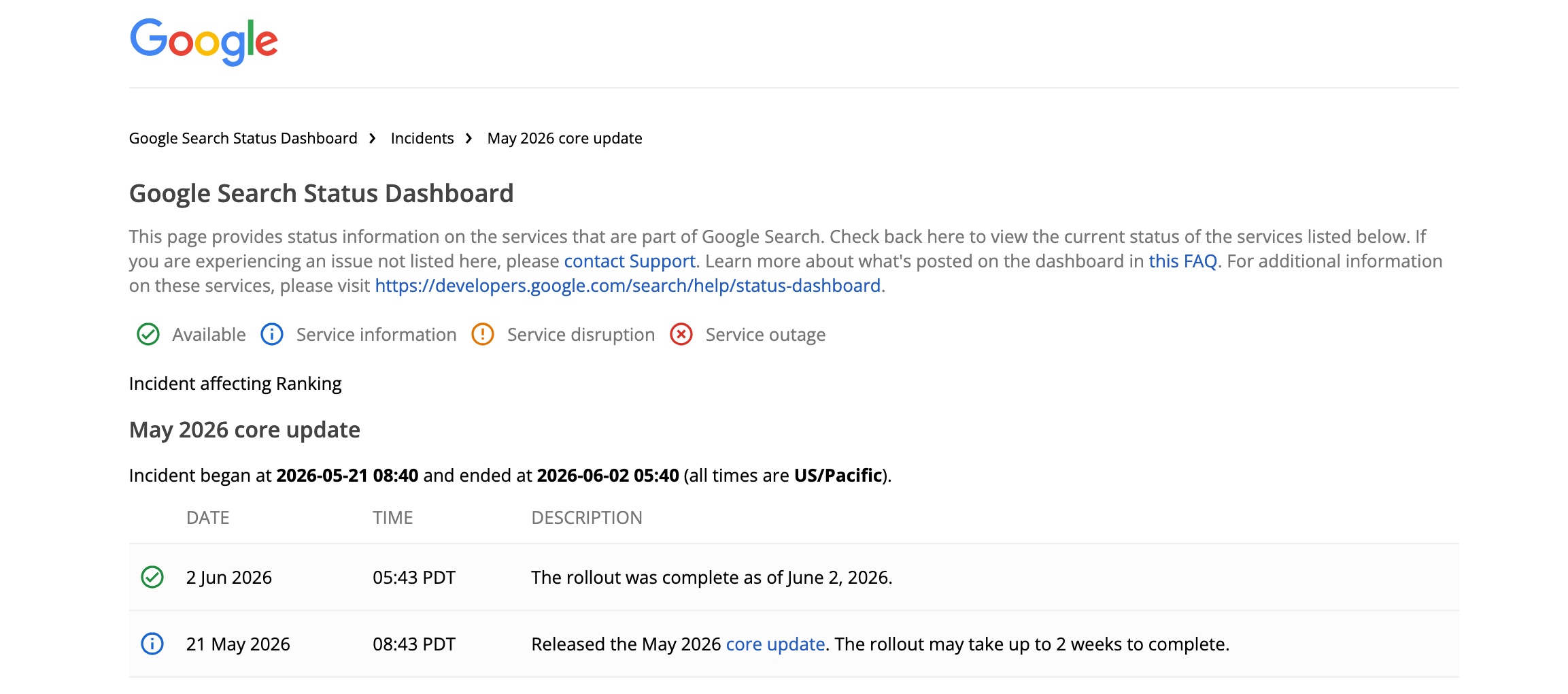
The update has now officially finished rolling out, but the disruption it caused was real. Sites that had already seen movement during the first weekend saw additional shifts again across the final stretch. Google described it as “a regular update designed to better surface relevant, satisfying content from all types of sites,” which is the standard language, but the pattern of repeated volatility across three separate weekends suggests this one had more moving parts than average.
If your traffic numbers changed significantly in the last two weeks, this update is the most likely cause. The next article covers exactly how to find out which factor actually hit you.
Read the full report from seroundtable.com ➞
Before you can fix a traffic drop, you need to know what caused it. Here is the most thorough diagnostic checklist available right now.
➞ Organic Traffic Down? Here Are 19 Ways to Find Out Why
Seer Interactive published an updated guide covering 19 specific ways to diagnose a drop in organic traffic, and they revised it for 2026 to include AI Overviews as a standalone cause. Most traffic declines trace back to a handful of root causes: seasonality, increased competition, keyword ranking shifts, technical errors, brand reputation issues, or AI Overviews absorbing clicks before users ever reach your result.
The guide walks through each one with specific tools and methods. For seasonality, compare year-over-year data in Google Analytics and search impressions in Google Search Console (GSC). For competition, check CTR curves and SERP feature changes. For ranking shifts, look at branded keyword data separately from non-branded. For technical issues, confirm crawlability, check for manual actions, and review Core Web Vitals.
The AI Overviews factor is the newest addition, and it matters: even when your ranking position holds, AI-generated responses at the top of the results can reduce click-through rates significantly. Diagnosing that requires looking at your GSC impression-to-click ratio, not just position.
This is the kind of reference you bookmark and return to every time something looks off.
Read the full report from seerinteractive.com ➞
While you monitor what is happening to existing traffic, Google also announced a new way for publishers and creators to build visibility on their own terms.
➞ Google Now Lets Publishers Build a Profile Directly in Search
Google announced Search Profiles on June 4th, giving publishers and creators a dedicated, shareable space inside Google Search to showcase their work. The profile pulls together your latest articles, videos, and social posts in one place, accessible through your Knowledge Panel, directly inside Discover, or via a custom URL.
The key mechanic: users who follow you from your Search profile are more likely to see your content in their Discover feed. This extends the follow feature Google introduced in late 2025 and gives publishers a more direct way to drive recurring visibility through Discover rather than depending entirely on search rankings.
To claim a profile now, you need a sizable following on at least one major social or video platform. You can customize it with an avatar, bio, links to your website and social accounts, and a pinned carousel that supports short-form video from Instagram, TikTok, and YouTube. Knowledge Panels for eligible publishers will be enhanced automatically once a profile is claimed.
This matters most for content-driven brands, media publishers, and individual creators. If your audience is on Discover and you have not thought about building there deliberately, this is a concrete starting point.
Read the full report from blog.google ➞
➞ From Google
Everything from Google search this week —
→ Google CEO Sundar Pichai Downplays Google Zero Concerns (searchenginejournal.com)
→ Google Confirms LLMs.txt Has No Current Implementation (searchenginejournal.com)
→ Google Discover Showing Threads Posts More Often (seroundtable.com)
→ ChatGPT Citations Changed After GPT-5.5, SISTRIX Data Shows (searchenginejournal.com)
→ Microsoft: AI Summarizes Results, Reducing Clicks & Website Visits (seroundtable.com)
→ DuckDuckGo Makes Its No-AI Search Engine Easier to Access as Traffic Booms (techcrunch.com)
→ Google Ads Terms of Service Updated for AI Changes After 8 Years (seroundtable.com)
→ Google Begins Limited Test of Healthcare Ads in AI Mode (seroundtable.com)
→ Google Ads New Branded Searches Controls for AI Max (seroundtable.com)
→ Commerce Media Expands Beyond Retail Sites with Demand Gen Integration (searchengineland.com)
→ Sundar Pichai: Google Search, AI Agents, and Tools Will Become One (searchengineland.com)
→ Google Discover Publisher Profile Pages Tests Short URLs (seroundtable.com)
→ Google Ads to Delete Short Term Performance Data June 1st (seroundtable.com)
→ New: Google Ads Prospects Mode (seroundtable.com)
→ Google Strongly Warns Against Manipulating Mentions for AI (seroundtable.com)
→ Google: Search Quality Raters Guidelines Not a Guide for Search Rankings (seroundtable.com)
→ Google Removes Lag for AI Overviews & AI Mode Showing Penalized Content (seroundtable.com)
→ Google Business Profile Detailed Rejection Notices (seroundtable.com)
→ Google Officially Appeals Search Monopoly Ruling (seroundtable.com)
→ EU May Fine Google Triple Million Euros Over Favoring Itself in Search Results (seroundtable.com)
→ Google Says AI Mode Can Now Scale Faster Across Languages (searchenginejournal.com)
→ New Ways to Find Your Favorite Sources and Original Content in AI Search (blog.google)
→ Google Tests Preferred Sources Label in AI Mode Citations (seroundtable.com)
→ Google Ads Costs Keep Rising, but Conversion Rates Improved in 2025 (searchengineland.com)
→ 100 Things We Announced at I/O 2026 (blog.google)
➞ AI + Social
Find out what’s happening in the social media and artificial intelligence world —
→ Anthropic Files to Go Public (techcrunch.com) – Anthropic has filed to go public, a major shift for the company behind Claude.
→ OpenAI Prepares to File to Go Public in Coming Weeks (nytimes.com) – Both major AI labs are now moving toward IPOs in the same window.
→ Codex for Every Role, Tool, and Workflow (openai.com) – OpenAI expands Codex availability beyond developers to broader business workflows.
→ OpenAI Frontier Models and Codex Now Available on AWS (openai.com) – OpenAI and AWS deepen their partnership, giving enterprise teams direct cloud access to frontier models.
→ Microsoft Scout Is a New AI Personal Assistant Built on OpenClaw (theverge.com) – Microsoft launches a new AI assistant aimed at personal productivity alongside its enterprise AI push.
→ Hackers Got Meta AI to Give Them Instagram Account Access (socialmediatoday.com) – A security incident raises questions about AI-powered account management features on Meta platforms.
→ LinkedIn Chatbot Optimization Tips Offer Guidance on Content Planning (socialmediatoday.com) – LinkedIn shares guidance for marketers on getting better results from AI-powered content tools.
→ YouTube Updates AI for Ask Studio and CTV (socialmediatoday.com) – YouTube rolls out AI improvements for creators and connected TV audiences.
→ Anthropic Releases Opus 4.8 with New Dynamic Workflow Tool (techcrunch.com) – Claude’s newest model adds workflow automation capabilities targeting complex multi-step tasks.
→ Similarweb: ChatGPT Shows More Links Leading to 150% Increase in Referrals (seroundtable.com) – ChatGPT’s shift toward showing more citations is sending meaningfully more referral traffic to publishers.
→ ChatGPT Ads Conversion-Optimized Campaigns Coming June 5th (seroundtable.com) – OpenAI moves forward with conversion-focused advertising campaigns inside ChatGPT.
→ Microsoft 365 Copilot Gets a Speed Boost and Cleaner Design (theverge.com) – Microsoft refreshes Copilot with faster performance and a redesigned interface across its productivity suite.
→ DuckDuckGo App Installs Surge in US After Google AI Changes (newsbytesapp.com) – Users pushing back on AI-heavy search are turning to DuckDuckGo in noticeable numbers.
→ Reddit Expands Shopify Integration Access Globally (socialmediatoday.com) – Reddit’s e-commerce integration with Shopify now reaches sellers worldwide.
→ YouTube Adds Conversational Custom Feed Generation (socialmediatoday.com) – YouTube lets users build personalized feeds using natural language prompts.
→ YouTube Will Now Automatically Label AI Videos (yahoo.com) – YouTube starts auto-detecting and labeling AI-generated video content.
→ Meta Launches Instagram, Facebook, and WhatsApp Subscriptions (yahoo.com) – Meta rolls out paid subscription tiers across its main platforms, including AI plan options.
→ TikTok Shop Grows to New EU Merchant Countries (socialmediatoday.com) – TikTok expands its social commerce push into more European markets.
→ AI Now Writes as Many Online Articles as Humans (graphite.io) – A significant milestone in AI-generated content, with implications for publishers and SEOs tracking content quality signals.
→ LinkedIn Wants to Limit the Reach of AI-Generated Content (socialmediatoday.com) – LinkedIn signals a shift toward rewarding original, human-authored content on the platform.
→ Report: LinkedIn Is Dominating B2B Queries in AI Chatbots (socialmediatoday.com) – LinkedIn content is pulling strong AI citation share for business and professional queries.
→ Bing Officially Releases AI Guided Image Search Experience (seroundtable.com) – Bing’s AI-powered image search is now fully live, adding another AI search surface to track.
→ Adthena Launches ChatGPT Ads Intelligence Platform (searchengineland.com) – A new tool lets advertisers track and analyze how brands appear in ChatGPT ad placements.
→ X Implements New Posting Restrictions on Nonpaying Users (socialmediatoday.com) – X continues tightening access for free accounts, limiting organic reach for non-subscribers.
➞ Worth Reading
These are the articles that will help you refine your marketing knowledge —
→ GSC’s New AI Overview Reporting: How Can We Use This Information? (mariehaynes.com)
→ 5 Places to Find FAQ Content That Improves AI Visibility (searchengineland.com)
→ I Tested Claude SEO Agents So You Don’t Have to (assertive-media.co.uk)
→ How People Are Using AI Mode in the US (storage.googleapis.com)
→ The New Rules of AI Visibility and How to Prepare for It (moz.com)
→ Your Inbox Might Be the Next AI Search Signal (ipullrank.com)
→ Is AI Killing Publisher Search Traffic? What The Guardian and Telegraph Think (sitebulb.com)
→ What’s a Visitor in the Age of AI? (joost.blog)
→ The AI Generation Gap: Why Young People Are Skeptical (barn2.com)
→ How to Use the New Lighthouse Report to See if Your Website Is Agent Ready (mariehaynes.com)
➞ What This All Means for Your Strategy
This week put three things in front of us at once: new data about where you stand, new tools to actually see it, and a core update that reminded everyone rankings still move fast.
The Search Console AI reports are worth checking the moment they appear for your site. They won’t tell you everything, but knowing whether your pages show up in AI Overviews is better than guessing. The listicle citation data is worth acting on for any commercial content you’re planning. And if your traffic shifted during the May update, the Seer diagnostic guide is the clearest path to finding the actual cause.
The Search Profiles launch is worth watching even if you can’t claim one yet. It signals that Google is building more ways for publishers to own their identity on Search, not just rank in it. That’s a shift worth paying attention to as Discover becomes a bigger slice of referral traffic.
Until next week,
Nishat from HighDegree* Marketing
P.S. Have a question about implementing these strategies? Hit reply – we read every email and often feature reader questions in future issues.
➞ Who is Nishat Shahriyar?
I’ve been a Digital Marketing Strategist since 2007. Today I’m the Product Marketing Lead at Fluent Forms (a WordPress form and lead-generation plugin used by 700K people), FluentPlayer (a WordPress Video Player Plugin) and Ninja Tables (a WordPress table builder plugin used by 80K people). Before that, I led marketing at Fluent Support (a WordPress helpdesk plugin used by 10K people).
Connect with me on LinkedIn or follow me on X/Twitter at @rednishat for SEO & Marketing updates.