AI content risks, zero-click SEO, Google’s advice, product packs, and why Condé Nast stopped forecasting search traffic.
Hello Marketers,
Welcome to the new issue of HighDegree* Marketing: Cutting Through the Noise in SEO & Digital Marketing
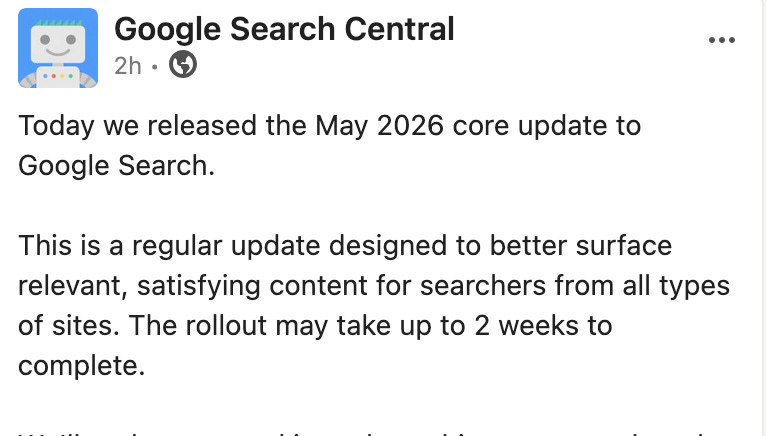
Starting this newsletter with a regular Google Update —
Search is going through one of its messiest stretches yet. AI content is blowing up in ways its sellers didn’t promise. Zero-click searches are eating publisher traffic alive. Google has quietly published a guide telling you what actually matters for AI search. Product pack data is reshaping ecommerce.
And the CEO of Condé Nast just told his teams to budget for zero search traffic. Every one of these stories connects to the same underlying shift: the old rules no longer hold, and the strategies built around them are starting to crack.
This issue breaks down what’s happening and, more importantly, what you should actually do about it.
Let’s jump in.
➞ In this Week
- AI content tools are producing short-term traffic spikes followed by steep, lasting drops
- 17 content types that can survive Google’s zero-click future (and the ones that can’t)
- Google published its own guide on optimizing for AI search, and it’s worth reading carefully
- Product pack data from 63,000+ merchants shows what actually drives ecommerce visibility
- Condé Nast’s CEO told teams to plan as if search traffic will be zero
- Everything from Google Search this Week
- Everything from Social Media and Artificial Intelligence World
- Articles that will Help You Refine Your Marketing Knowledge
➞ Subscribe
If you are not subscribed to HighDegree* yet, please subscribe to us by clicking the “Subscribe” button below. I will post every issue to HighDegree* substack version, so you can get it instantly in your inbox every time I hit publish!
Thanks for reading HighDegree* Marketing! Subscribe for free to receive new posts and support my work.
➞ AI content tools are producing short-term wins, then crashing sites
SEO analyst Lily Ray monitored more than 220 websites that had publicly identified themselves as customers of AI content creation platforms. What she found should give any site owner pause. Across the dataset, 54% of sites lost 30% or more of their traffic peak, 39% lost 50% or more, and 22% lost 75% or more. The typical pattern: rapid page growth over 6 to 12 months, a traffic peak, then a steep drop that often fell below where the site started.
The problem isn’t the tools themselves. It’s the playbooks. Eight content templates appear repeatedly across declining sites: VS comparison pages at scale, “What is X” glossary pages, “Best X for Y” listicles, self-promotional listicles where the brand names itself number one, competitor-alternatives pages, programmatic location or language scaling, FAQ farms built for AI extraction, and off-topic content published at volume. Any of these can work for a while. When they’re scaled with AI, Google eventually catches up.
Ray’s conclusion: AI tools can genuinely help with research, content briefs, and speeding up workflows where a human expert is still reviewing the output. The risk starts when the goal becomes pure volume, and the people publishing the content stop reading it.
Read the full report from lilyraynyc.substack.com ➞
The content types worth building in a zero-click world look very different from what got sites hit here.
➞ 17 content types that can actually survive zero-click search
Nearly 60% of Google searches now end without a click to any third-party website. That number is climbing, and Google’s AI Mode will push it higher. So what kind of content still earns visits?
Cyrus Shepard reviewed hundreds of winning and losing websites and identified 17 content types that perform well in the AI era. The strongest ones share a few characteristics: they’re proprietary, experience-based, niche-focused, and allow users to complete a task rather than just get information.
At the top of the list: owned audiences (email newsletters), transaction pages, and original research. These are hard to replicate and hard for AI to replace. Further down the list are things like in-depth reviews with firsthand testing, user-generated communities, expert perspectives, and templates. At the weaker end sit guides, FAQs, glossaries, and roundup lists, which AI can summarize easily and competitors can copy overnight.
The takeaway isn’t that guides are dead. It’s that guides need to be backed by proprietary data, original expertise, or a viewpoint that couldn’t have come from anyone else. The days when a well-optimized generic article ranked reliably are behind us. Content that survives the next few years is content built around something you own: your data, your experience, or your audience.
Read the full report from signal.zyppy.com ➞
Which brings us to what Google itself is now saying about what works.
➞ Google published its own AI search optimization guide. Here’s what it actually says.
Google released an official guide on optimizing for generative AI features in Search, covering AI Overviews, AI Mode, and the underlying ranking systems that feed them. The headline message: SEO still works. The same foundations that earn rankings in regular search, quality content, clear technical structure, good page experience, earn visibility in AI responses too, because AI features are built on top of Google’s core ranking systems using a technique called Retrieval-Augmented Generation (RAG).
More interesting is what Google says you can ignore. LLMS.txt files aren’t necessary. You don’t need to break content into “chunks” for AI to understand it. You don’t need to rewrite content in a specific way for AI search. And trying to earn inauthentic mentions across the web won’t help, because Google’s spam systems catch it.
What Google does emphasize: create content that provides a unique point of view, content that isn’t just a restated version of what already exists, and content your readers would genuinely find satisfying after reading. Google also says structured data isn’t required for AI search, though it’s still worth using for rich results. The guide is straightforward, practical, and refreshingly free of vague advice. Worth reading directly if you haven’t yet.
Read the full report from developers.google.com ➞
That clarity from Google matters especially for ecommerce, where product visibility is shifting fast.
➞ Google product packs are now a primary sales channel. The data tells you how to win.
An analysis of more than 63,000 merchants across a broad set of ecommerce keywords found that Google’s product packs and scrollable carousels have moved from supplementary feature to primary purchase touchpoint. Some search results now show up to 60 individual organic product listings on a single page.
The data, pulled with help from Nozzle, reveals a gap that most brands miss: appearing in product packs and actually getting traffic from them are two different things. eBay appears in product results for more keywords than Home Depot, but Home Depot generates nearly nine times as much estimated traffic from those appearances. The difference is position quality within the pack. Visible, above-the-fold placements drive clicks; listings buried behind scrolling don’t.
On discounting: the data shows no consistent relationship between promotional pricing and better placement. Feed quality, category relevance, image standards, and review signals carry more weight. Smaller specialist brands are competing directly with major retailers when they have genuine category depth. The channel rewards focus over scale. For any ecommerce brand still treating product packs as a side consideration, the window to get ahead of this is narrowing.
Read the full report from searchengineland.com ➞
The bigger picture behind all of this is what the Condé Nast CEO said out loud this week.
➞ The Condé Nast CEO just said what many publishers won’t admit
Roger Lynch, CEO of Condé Nast (Vogue, The New Yorker, Wired, GQ), told his teams to plan their businesses as if search traffic were zero. Not because he expects it to literally reach zero, but because three consecutive years of internal forecasts underestimated the actual decline. Every year, search traffic fell further than predicted.
Lynch described what has changed on the search results page: what used to be a few ads and ten blue links is now an AI Overview, rows of commerce listings, sponsored results, and then organic results buried on the second page or further. He expects search to settle at a single-digit share of total traffic for most publishers.
His observation about what’s surviving is the most useful part for smaller publishers: the brands doing well are on either end of a barbell. Large, authoritative brands in major categories (Vogue) and small, niche publications with loyal, paying audiences (Pitchfork) are both holding up. The brands in the middle, without deep authority or strong niche focus, have no clear path forward.
Condé Nast’s digital subscriptions grew 29% last year. The company raised prices repeatedly and retention improved each time. Lynch’s message for anyone running a content business: build something specific enough that people will pay for it or seek it out directly. That’s the only hedge that holds.
Read the full report from searchenginejournal.com ➞
➞ From Google
Everything from Google search this week —
→ Google search ranking volatility heated May 13th and 14th (seroundtable.com)
→ Google Discover performance report missing data May 7 and May 8 (seroundtable.com)
→ Google says search query reports may not show actual user searches (searchengineland.com)
→ Google AI Mode now showing direct hotel booking links inside responses (seroundtable.com)
→ Google confirms spam policies apply to AI Overviews and AI Mode (seroundtable.com)
→ Google drops FAQ rich results in search and Search Console (seroundtable.com)
→ Google Discover publisher pages getting links and featured posts (seroundtable.com)
→ Google Analytics AI Assistant now tracks ChatGPT, Gemini, and Claude traffic (seroundtable.com)
→ Google Ads to auto-link YouTube channels starting June 10 (searchengineland.com)
➞ AI + Social
Find out what’s happening in the social media and artificial intelligence world —
→ OpenAI adds product feed ads to ChatGPT (searchengineland.com) – ChatGPT now serves shopping ads with product feeds, putting it in direct competition with Google Shopping for commercial intent queries.
→ Microsoft starts canceling Claude Code licenses (theverge.com) – Microsoft is pulling back on Claude Code access for employees, signaling a shift in how the company is managing its AI tool stack.
→ X implements new posting restrictions on nonpaying users (socialmediatoday.com) – X has tightened limits on what free accounts can post, continuing its push to convert users to paid subscriptions.
→ TikTok World 2026: major ad tool announcements (socialmediatoday.com) – TikTok rolled out a batch of new advertising tools at its annual marketing event, with several features aimed at direct-response campaigns.
→ LinkedIn will enable consultants to book business directly from their profile (socialmediatoday.com) – A new feature lets independent professionals accept bookings and payments without leaving LinkedIn, reducing friction for service-based businesses.
→ WhatsApp adds an incognito mode in Meta AI chats (techcrunch.com) – WhatsApp users can now chat with Meta AI without the conversation being stored, a privacy option that may ease adoption in markets sensitive to data collection.
→ Grok downloads fall nearly 60% (socialmediatoday.com) – Interest in xAI’s Grok has dropped sharply since its launch spike, suggesting early curiosity hasn’t translated into sustained adoption.
→ LinkedIn uses AI to improve feed relevance (socialmediatoday.com) – LinkedIn is applying AI ranking models to its feed to surface content more relevant to each user’s professional interests and activity.
→ OpenAI launches the OpenAI Deployment Company to help businesses build around intelligence (openai.com) – A new OpenAI unit focused on helping enterprises implement AI products more systematically, rather than just providing API access.
➞ Worth Reading
These are the articles that will help you refine your marketing knowledge —
→ How to optimize content for social search on Meta technologies (facebook.com)
→ Google quietly gave 54 publishers control over their Discover profiles. Here’s what they did with it. (searchengineland.com)
→ How to reverse-engineer LLM brand visibility and why it matters (searchengineland.com)
→ Google may be about to widen the SEO playing field (searchengineland.com)
→ Schema markup didn’t move AI citations in Ahrefs test (searchenginejournal.com)
→ Why vibe coding is becoming an SEO advantage (searchengineland.com)
➞ What This All Means for Your Strategy
Every article in this issue points at the same thing: traffic from Google search is no longer something you can plan around with confidence. The AI content boom is producing crashes, not just for sites that obviously gamed the system, but for sites that scaled without enough human oversight. Zero-click search is shrinking the pool.
Google’s own guide confirms that what survives is original, useful, hard-to-replicate content. Ecommerce brands need to think about product pack visibility the way they used to think about ranking positions. And if the CEO of a portfolio that includes Vogue and The New Yorker is telling his teams to budget for zero search traffic, smaller publishers should be asking hard questions about how dependent they are on that channel.
The path through this isn’t panic or abandoning search entirely. It’s building things that don’t rely on algorithm generosity: an email list, original research, genuine category authority, or a niche audience willing to come back on its own. That work takes longer. It also holds up better.
Until next week,
Nishat from HighDegree* Marketing
P.S. Have a question about implementing these strategies? Hit reply – we read every email and often feature reader questions in future issues.
➞ Who is Nishat Shahriyar?
I’ve been a Digital Marketing Strategist since 2007. Today I’m the Product Marketing Lead at Fluent Forms (a WordPress form and lead-generation plugin used by 700K people), FluentPlayer (a WordPress Video Player Plugin) and Ninja Tables (a WordPress table builder plugin used by 80K people). Before that, I led marketing at Fluent Support (a WordPress helpdesk plugin used by 10K people).
Connect with me on LinkedIn or follow me on X/Twitter at @rednishat for SEO & Marketing updates.