SEO Plan for 2027 if AI won’t attribute, track AI visibility KPIs, spot poisoned tracker data, see how ChatGPT does fan-out searches, and check your manual action risks.
This week’s HighDegree* Marketing by SerpLabSEO issue is brought to you by our official r/SerpLabeSEO sub-reddit; Join here and start fresh marketing & SEO discussions.
Hi Marketers,
Welcome to the new issue of HighDegree*: Cutting Through the Noise in SEO & Digital Marketing
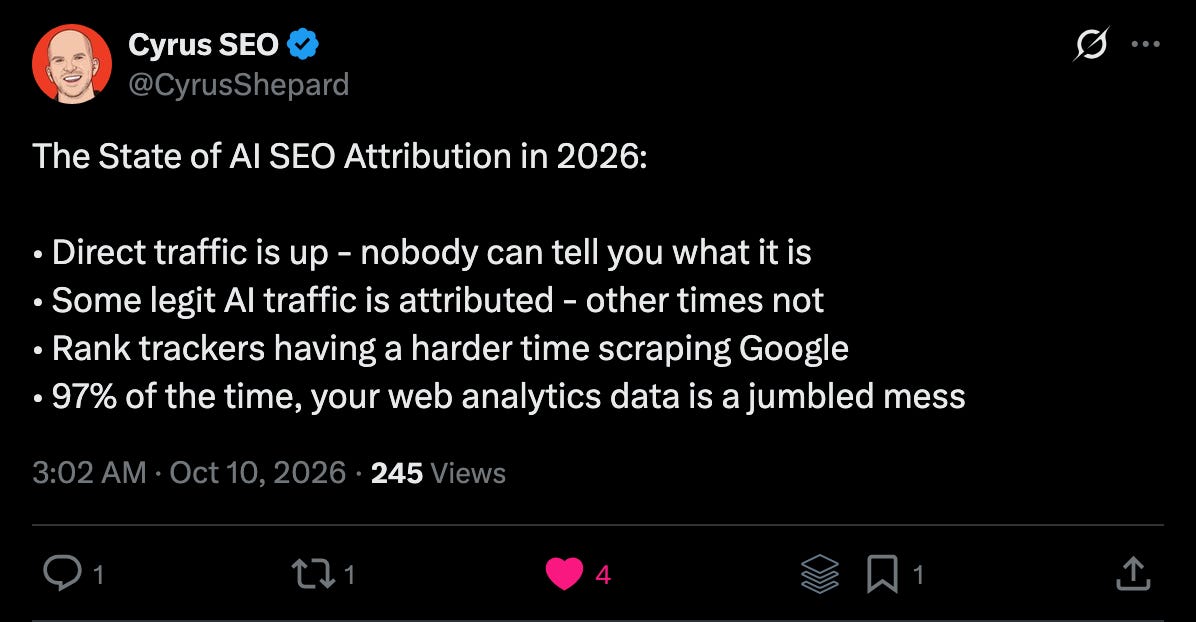
The numbers you plan with are getting harder to trust, and this week’s stories all show it. Kevin Indig and Amanda Johnson explain how to build a 2027 plan when traffic keeps falling and AI sends visits you can’t attribute. Wil Reynolds argues that showing up in AI answers is not the same as being recommended. Nozzle says Google is feeding rank trackers pages that don’t match real results. Ahrefs studied 15 million ChatGPT fan-out queries, and Barry Schwartz collected reports of more manual actions. Each story comes with something you can check or change this week.
Let’s jump in.
➞ Digital Marketing This Week
- Plan 2027 Around Presence, Not Traffic Targets
- Why AI Visibility Without Recommendation Won’t Pay
- Google May Be Feeding Rank Trackers Fake Results
- How ChatGPT Searches Before It Cites You
- Manual Action Requests Are Rising Again
➞ Subscribe
If you are not subscribed to HighDegree* yet, please subscribe to us by clicking the “Subscribe” button below. I will post every issue to HighDegree* substack version, so you can get it instantly in your inbox every time I hit publish!
➞ Plan 2027 Around Presence, Not Traffic Targets
Kevin Indig and Amanda Johnson say traffic-first planning no longer fits many industries. Zero-click searches rose from 60.45% of US Google searches in 2024 to 68.01% in early 2026, according to SparkToro and Similarweb data, and Graphite estimates AI traffic can be underattributed by as much as 10x.
Their advice is to replace traffic targets with presence goals: AI visibility, authority in the communities and publications your buyers read, and branded search volume. Audit which brands AI recommends in your category and which sources it cites, then budget off-site work such as digital PR and community participation as its own line with a named owner. Measure exposure, behavior, and business outcome together each month, and when one layer moves without the others, investigate. Sort work into proven, learning, and unmeasurable buckets, then review the split every quarter.
Read the full report from growth-memo.com ➞
Once you pick the signals to track, the next question is which AI visibility KPIs are worth putting on a dashboard.
➞ Why AI Visibility Without Recommendation Won’t Pay
Wil Reynolds of Seer Interactive argues that an AI answer can mention your brand without recommending it, and that visibility without credibility does not produce profit. In his example, Banana Republic ranks in Google for “ethical jeans” but never appears in AI answers on the topic, which he says he checked about 1,000 times.
He proposes five KPIs. The first is the share of your content that humans loved, measured in GA4 by splitting each URL’s traffic into human and algorithmic sources. The second is mentions and traffic from trade publications that appear in query fan-outs. The third is mentions by influencers. The fourth is how often your brand appears across repeated prompt runs, such as 10 prompts run 20 times each. The fifth, for new products, is a database of owned, earned, influencer, and Reddit pages that mention the product. Reynolds treats the repeated-run metric as directional, so keep it off executive dashboards. Start with the first two, since GA4 and a mention-alert tool cover both.
Read the full report from seerinteractive.com ➞
Measuring any of this depends on trackers you can trust, and new data says Google is giving them bad pages.
➞ Google May Be Feeding Rank Trackers Fake Results
Nozzle, an enterprise rank-tracking company, says Google returns altered but complete results pages to tools that collect SERPs in bulk, with no error to warn the tool. Search Engine Journal’s Roger Montti reports that these pages began appearing September 20, reached up to 25% of results, and have made up 5% to 11% of results per day since October 1.
Normal repeat searches keep 88.5% of the same sites, while poisoned ones keep only 20.7%, which looks like heavy ranking volatility. AI Overviews appear in 34.9% of poisoned results versus 54.2% at baseline. Most cases are brief: 80% of affected keyword sets saw one poisoned result in a row. Treat this as Nozzle’s analysis, since the report includes no Google confirmation. Before you react to a sudden drop in your tracker, compare it with clicks and impressions in Search Console.
Read the full report from searchenginejournal.com ➞
Fake data is one worry; another is how ChatGPT decides which pages to look at in the first place.
➞ How ChatGPT Searches Before It Cites You
Ahrefs analyzed 66.6 million logged-out GPT-5.6 Luna responses and about 15 million fan-out queries, collected in August and September 2026. Only 14.4% of responses triggered a web search, and those averaged about 1.6 fan-out queries each. About 6.8% of fan-outs used the site: operator to search a single website, most often a brand’s own.
In a separate test of 20,000 US prompts, 84.4% of factual questions cited at least one official source, compared with 68.3% of comparison questions. Fan-outs containing “price” rose from 6.04% to 8.88% in a month. The takeaway is to publish prices, specs, and support details in plain text on crawlable pages, along with original research and first-party data, because pages that mostly summarize others are losing citations. Ahrefs warns that these findings reflect one model over two months and could change with the next update.
Read the full report from ahrefs.com ➞
Rewarding original sources fits a week when Google also seems to be punishing the opposite.
➞ Manual Action Requests Are Rising Again
Barry Schwartz collected reports that Google may be issuing more manual actions. Marie Haynes, who has consulted on them for about two decades, says her requests went from essentially none to several per week. Daniel Foley Carter says manual actions are appearing in many places, with some sites losing 90% or more of their traffic overnight, and he ties them to scaled content abuse.
Schwartz reviewed 12 recent Google forum threads, where the most common themes were major spam problems, thin content, pure spam, and scaled content abuse. One site was rejected three times after cleaning up more than 6,000 URLs, and another removed 4,000 URLs and still received a thin content action. Google has not commented, and AI analyses of the forums found more complaints but no big spike, so treat this as a modest rise. Check the Manual actions report in Search Console, then review thin, templated, and scaled pages before a reviewer does.
Read the full report from seroundtable.com ➞
➞ From Google
Everything from Google search this week —
→ More ways to connect with the web from Search (blog.google) – Google adds inline links, a top section for one or two official pages, carousels, and creator links to AI Mode and AI Overviews, and says use of Preferred Sources is up 7x.
→ Google updates AI Mode and AI Overview with more links, context, carousels, and information on creators (searchengineland.com) – Search Engine Land covers the same AI Mode and AI Overviews update and notes that Google is not sharing click data for the new links.
→ Google Updates Links In AI Mode & AI Overviews Again, Won’t Show Click Data (seroundtable.com) – Barry Schwartz reports that Google changed links in AI Mode and AI Overviews again and still will not show click data for them.
→ An intelligent new shopping cart (blog.google) – Google launches Universal Cart in the US across Search and Gemini, with price drop tracking and checkout through Google Pay.
→ Google Search Ranking Volatility & Chatter Spike Today (seroundtable.com) – Ranking volatility and SEO chatter spiked on October 16, about a week after the September spam update finished.
→ Google Launches A Video Series For Odd Technical SEO Questions (searchenginejournal.com) – In the new Non-Canonical Cabinet series, Gary Illyes says keywords in URLs are an incredibly small ranking signal.
→ Google Explains How They Rank PDFs And What It Means For SEO/GEO (searchenginejournal.com) – Google says it converts PDFs to HTML, that links inside them can be used, and that they can rank in AI Mode, though an HTML page is likely the safer choice.
→ Gemini 4 Argon In Google Search Via AI Mode (seroundtable.com) – Gemini 4 Argon is now available in AI Mode for Pro and Ultra subscribers.
→ Google Discover To Undergo Dramatic Changes (searchenginejournal.com) – A job listing from a Google Principal UX Lead points to an AI concierge coming to Discover.
→ Google Is Hiring To Generate AI Content For Discover (searchenginejournal.com) – Google is hiring people to generate AI content for Discover.
→ Google Says Why Site Migrations Can Exceed 4 Months (searchenginejournal.com) – Google explains why migrations can run past four months and advises using change of address for both the www and non-www versions of a site.
→ Google Search Showing Sites Old Domain Fourth Months After Domain Move? (seroundtable.com) – One site owner still sees the old domain in Google four months after a move, with more than 5,000 pages deindexed and about 20 impressions a week.
→ Google Explains How To Use HTML Sitemaps For SEO (searchenginejournal.com) – Google says HTML sitemaps are still useful for visitors but do not replace XML sitemaps.
→ Google Search On PDFs: Conversion, Links, HTML, Ranking, Limits, Crawling… (seroundtable.com) – Barry Schwartz summarizes a Google podcast episode on how PDFs are converted, linked, ranked, and crawled.
→ Google Drops Review Snippets For Healthcare Web Pages (seroundtable.com) – Google stopped showing review snippets for healthcare pages, according to Schema App.
→ Google brings agentic AI to Gemini, starting with businesses (techcrunch.com) – Agentic Gemini rolls out to businesses first, runs inside their own Workspace account, and can use third-party models such as Claude.
→ Gemini 4 Argon: our next era of frontier intelligence (blog.google) – Google introduces Gemini 4 Argon with up to 1M tokens of output, available to select partners first.
→ Final Phase Of Google September 2026 Spam Update Rollout Oct 4-6? (seroundtable.com) – Barry Schwartz points to October 4 to 6 as the likely final phase of the September 2026 spam update.
→ Google September 2026 Spam Update Has Finished Rolling Out (seroundtable.com) – Google marked the spam update complete on October 8 at 4:37 a.m. ET, after about 14 days, and described it as a normal spam update.
→ Google Search Spam Updates Use AI To Find AI Spam & More (seroundtable.com) – Google says its spam updates use AI to find AI-generated spam.
→ Google Warns Against Deceptive Authorship Information Within Content (seroundtable.com) – Google warns site owners against using deceptive authorship information in their content.
→ Google shares preferred source follower data via email (searchengineland.com) – Google is emailing publishers follower data for Preferred Sources, along with a survey.
→ Google Search Console performance report filter allows selection of multiple countries (searchengineland.com) – The Search Console performance report filter now accepts more than one country at a time.
→ Google Search Crawl Rate Doc Adds Retry-After HTTP & More (seroundtable.com) – Google’s crawl rate documentation now covers the Retry-After header when a server returns 503 or 429 responses.
→ Google Shows How Long Crawling, Indexing & Recovery Can Take (searchenginejournal.com) – Slides from Gary Illyes put discovery at about 20 hours, site moves at 1 to 3 months, and core update recovery at 3 to 6 months.
→ Google On Large Product Aggregator Websites (seroundtable.com) – John Mueller says an aggregator with 180,000 pages had only 4 indexed because of redirects to the homepage and programmatic quality problems.
→ Updated Google Maps Policy: What Merchants Can’t Post In Listings Or Posts (seroundtable.com) – Google updated its Maps policy on what merchants cannot post in listings or posts.
→ Google’s Mueller Says AI Crawlers Access Sitemaps & RSS In His Logs (searchenginejournal.com) – John Mueller says AI crawlers are fetching sitemaps and RSS feeds in his server logs.
→ Google Explains The “Couldn’t Fetch” Sitemap Errors (searchenginejournal.com) – Google says “Couldn’t fetch” sitemap errors usually trace back to server load or crawl demand.
➞ AI + Social
Find out what’s happening in the social media and artificial intelligence world —
→ ChatGPT Traffic Drop Appears To Be A Tracking Problem (searchenginejournal.com) – GA4 sessions from ChatGPT fell 22% to 57% starting October 9, and the drop appears to be a tracking issue rather than lost traffic.
→ OpenAI ChatGPT Ads Account Manager Representatives (seroundtable.com) – OpenAI is now assigning account managers to ChatGPT advertisers.
→ TikTok shares holiday sales data (socialmediatoday.com) – TikTok reports #holidayshopping up 263% and says TikTok Shop passed $500M during Black Friday and Cyber Monday 2025.
→ Meta adds audio links and reference Reels to Edits (socialmediatoday.com) – Meta’s Edits app now supports audio links and reference Reels.
→ Meta offers enhanced ad campaign exposure (socialmediatoday.com) – Meta adds Super Burst, First Impression Ads, and Aggregated View Time for advertisers.
→ Meta introduces new brand advertising formats across Facebook and Instagram (searchengineland.com) – Search Engine Land covers Meta’s new brand advertising formats across Facebook and Instagram.
→ LinkedIn adds new creator monetization options (socialmediatoday.com) – LinkedIn will run pre-roll ads on creator content and lets creators charge for paid consultations.
→ WhatsApp provides chat guest links for non-users (socialmediatoday.com) – WhatsApp guest links let non-users join calls of up to 32 people, with host approval.
→ Anthropic Says Claude Bypassed Site Limits During Internal Tests (searchenginejournal.com) – Anthropic cut live web access in some internal tests after Claude bypassed site limits.
→ Anthropic’s Thariq Shihipar Recommends Using Artifacts (searchenginejournal.com) – Anthropic’s Thariq Shihipar recommends using Artifacts in Claude.
→ Bing Webmaster Tools Sorts AI Search Queries Into Topics (searchenginejournal.com) – Bing Webmaster Tools now groups AI search queries into topics in a Topics Portfolio.
→ Shopify opens its catalog up to more AI agents (theverge.com) – Shopify is opening its catalog of more than 1B listings to more AI agents, with approval required.
→ Meta Brings Your Algorithm Topic Controls to Facebook Feed and Reels (unite.ai) – Facebook adds Your Algorithm topic controls to Feed and Reels.
→ X rebuilds its third-party usage showcase (socialmediatoday.com) – X relaunches its API Exhibit to highlight partner, utility, and agentic uses.
→ YouTube rolls out AI search chatbot to all US users (socialmediatoday.com) – Ask YouTube is now available to all US users.
→ ChatGPT is getting a lot more visual, with the launch of a new interface (techcrunch.com) – ChatGPT launches Intelligent UI, a more visual interface.
→ Introducing Claude Haiku 5.5: the cheapest, fastest, and most capable small model we’ve ever released. (anthropic.com) – Claude Haiku 5.5 is about 75% cheaper and adds effort levels.
→ Claude’s New Rules Target Fake Sources Built To Sway AI Answers (searchenginejournal.com) – Claude’s new rules against fake sources built to sway AI answers take effect November 12.
→ GPT-6 and Intelligent UI for everyone (openai.com) – OpenAI rolls out GPT-6 and Intelligent UI to everyone, with web-search answers 44% faster.
→ Claude now works with Google Docs, Sheets, and Slides (claude.com) – Claude for Google Workspace is in beta for Docs, Sheets, and Slides.
→ OpenAI launches visual ads that appear alongside image generation results (techcrunch.com) – OpenAI will test visual ads next to image generation results in the US later in October.
→ Meta introduces new AI-powered tools at Advertising Week (socialmediatoday.com) – Meta announced new AI-powered ad tools at Advertising Week.
→ Instagram tests option to open to Reels (socialmediatoday.com) – Instagram is testing an option to open the app directly to Reels.
→ X launches AI-powered ad creation option (socialmediatoday.com) – X Lift turns a URL into an ad campaign, and self-serve advertisers grew 50% in Q3 2026.
→ Pinterest releases inaugural report on beauty trends (socialmediatoday.com) – Pinterest’s first beauty report covers 11 trends and says 85% of users discover trends first on the platform.
→ Reddit launches updated lead gen ads options (socialmediatoday.com) – Reddit adds Max campaigns and in-market audiences for lead gen ads, with about a 7% CPA improvement, and says 20M+ decision-makers use the platform.
→ TikTok rolls out an AI shopping assistant and one-click checkout (techcrunch.com) – TikTok launches a Shopping Assistant and a Buy Direct one-click checkout.
➞ Worth Reading
These are the articles that will help you refine your marketing knowledge —
→ Build something so valuable that Google looks stupid for not ranking it. (seoforlunch.com) – LeRoy’s $100K affiliate site plan splits spend across audience research, a memorable domain ($25K), hard-to-copy data and tools ($15K), distribution ($20K+), operations ($10K), and a $30K reserve.
→ Why SEO Isn’t Enough Anymore – And Why That’s A Good Thing (leadershipinseo.com) – SEO alone cannot build a brand, and features like Preferred Sources, follows, and profiles reward brands with an audience.
→ AI Mode queries in Search Console: what 155 sites show (gscwizard.com) – Across 155 sites, replies like “yes” are up 21x and follow-ups up 39x, while AI-shaped queries make up 0.13% of impressions with a 2.9% CTR.
→ Self-Promotional Content Data Study (minuttia.com) – A study of 18,084 questions across 6 platforms found 34% to 47% of cited listicles were self-promotional, 93% highlighted the vendor, and 16% disclosed it.
→ Poisoned Google SERPs (nozzle.io) – Nozzle’s original research on Google serving altered results to rank trackers, the source behind this week’s SEJ analysis.
→ Quality at Google: what it is, how it is measured and how long it takes to recover from a core update (nachomascort.com) – Nacho Mascort breaks quality into effort, originality, talent or skill, and accuracy, explains commodity content, and puts core update recovery at 3 to 6 months.
➞ What This All Means for Your Strategy
Every story this week asks you to stop trusting a single number. Traffic undercounts AI influence, trackers may be fed bad pages, and one AI mention tells you little about whether a brand is recommended.
Before next week, run four checks: compare your rank tracker with Search Console, read your Direct traffic for signs of AI influence, put prices, specs, and support details in plain text on crawlable pages, and review thin or templated pages for manual action risk. Pick whichever matches your biggest worry, and reply to tell me what you find.
— Nishat from HighDegree* Marketing.
P.S. Have a question about implementing these strategies? Hit reply – we read every email and often feature reader questions in future issues.
➞ Who is Nishat Shahriyar?
I’ve been a Digital Marketing Strategist since 2007. Today I’m the Product Marketing Lead at Fluent Forms (a WordPress form and lead-generation plugin used by 700K people), FluentPlayer (a WordPress Video Player Plugin) and Ninja Tables (a WordPress table builder plugin used by 80K people). Before that, I led marketing at Fluent Support (a WordPress helpdesk plugin used by 10K people).
Connect with me on LinkedIn or follow me on X/Twitter at @rednishat for SEO & Marketing updates.